BLS Structural Steel
China’s steel factories operate at a scale few industrial systems can match. The World Steel Association reports that China produced about 1.005 billion tonnes of crude steel in 2024. This represented more than half of global output. Such volume makes process control essential, not optional.
Understanding how steel materials are processed in factories requires following the production route closely. Iron ore, coke, and recycled scrap enter different preparation systems. Blast furnaces reduce iron ore into hot metal. Electric arc furnaces melt scrap or direct-reduced iron. Ladle refining adjusts chemistry, temperature, and cleanliness before continuous casting forms slabs, blooms, or billets. The World Steel Association’s World Steel in Figures 2025 highlights the importance of both integrated and electric steelmaking routes.
The work becomes more precise after casting. Reheating furnaces prepare semi-finished products for hot rolling. Rolling mills reduce thickness while controlling shape, surface quality, and mechanical performance. Cold rolling, annealing, pickling, galvanizing, and cutting may follow. Technicians inspect dimensions, chemical composition, tensile strength, and surface defects against customer specifications and applicable standards, including China’s GB/T system.
Small details matter. A temperature shift can change grain structure. A poor descaling operation can leave visible marks. Modern plants use automated sensors, spectrometers, machine vision, and digital production records. Reports from the International Energy Agency also identify steelmaking as a major industrial emissions source, increasing pressure for energy efficiency and low-carbon production. Yet factory performance is not perfectly uniform. Equipment age, raw-material quality, and operator judgment still influence results. That uncertainty deserves honest attention when evaluating how steel materials are processed in factories.
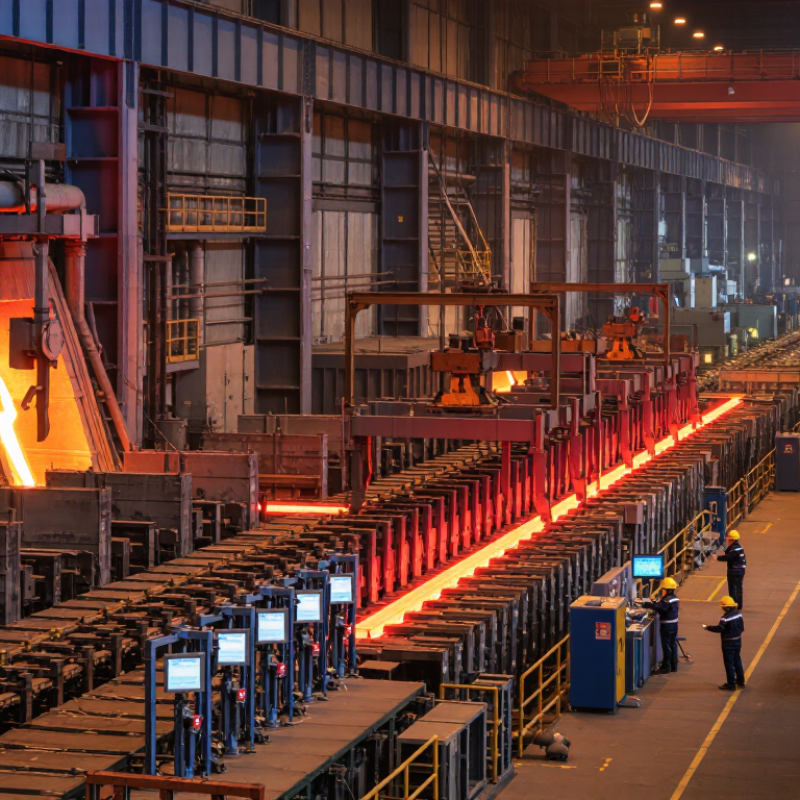
China’s steel factories handle several material families, each matched to a different industrial need. According to World Steel in Figures 2024, China produced about 1.019 billion tonnes of crude steel in 2023. This represented more than half of global output. Carbon steel remains common in construction beams, reinforcing bars, bridges, and machinery frames. Its strength, cost, and easy forming support large-scale projects.
Low-alloy steel adds elements such as chromium or nickel for better strength and wear resistance. Factories use it for pressure vessels, mining equipment, heavy vehicles, and energy infrastructure. Stainless steel resists corrosion in food-processing equipment, chemical plants, medical tools, and architectural panels. Flat steel is reheated, rolled, pickled, annealed, or coated. Galvanized sheet protects automobile panels, roofing, ducts, and appliance housings. Long products are cut, straightened, threaded, or welded for construction work.
The International Energy Agency reports that steelmaking remains one of the largest industrial sources of carbon dioxide emissions. This pressure is changing factory choices. Electric arc furnaces can process more recycled steel, while basic oxygen furnaces still dominate large integrated plants. Quality checks measure thickness, surface defects, tensile strength, and chemical composition. Real factory conditions are less uniform than brochures suggest. Regional standards, equipment age, and operator skill can affect results. That gap deserves closer inspection.
Steel production in Chinese factories begins long before molten metal enters a furnace. Factory teams inspect iron ore, scrap steel, limestone, and alloy additions. They check moisture, particle size, chemical composition, and visible contamination. A wet charge can waste energy and create unstable furnace conditions. Scrap is sorted by grade and cut into manageable pieces. Sampling matters. Technicians take several samples because one handful cannot represent an entire truck. Materials are weighed and blended according to the target steel grade. Mistakes still occur.
In integrated plants, coke and sintered ore feed a blast furnace, where hot air supports reduction. The furnace separates iron from oxygen and produces hot metal. Electric arc furnaces melt selected scrap with electrical energy and, when needed, direct-reduced iron. Operators monitor temperature, carbon content, slag height, and power use throughout the heat. Lime and other fluxes combine with impurities, forming slag for removal. This stage requires judgment, not only automated control. Small changes in scrap chemistry can alter the entire heat.
After melting, ladle refining adjusts alloy content and temperature. Argon stirring helps distribute elements and release unwanted gases. Vacuum treatment may reduce hydrogen in demanding applications. The steel then moves to continuous casting, becoming slabs, blooms, or billets. Quality records should connect each cast with raw materials and test results. That traceability sounds simple, but rushed checks can weaken confidence. Better plants review those failures instead of hiding them.
| Process Stage | Main Materials or Inputs | Typical Equipment | Key Operating Data | Primary Output | Quality and Process Controls |
|---|---|---|---|---|---|
| 1. Raw Material Receiving and Inspection | Iron ore fines, lump ore, pellets, metallurgical coke, limestone, dolomite, recycled steel scrap, ferroalloys, and process additives. | Weighbridges, sampling systems, belt conveyors, stockyards, magnetic separators, and laboratory analyzers. | Moisture, particle size, chemical composition, foreign-material content, and bulk density are checked before use. | Accepted and classified raw materials stored in designated batches. | Sampling follows plant quality procedures. Typical tests include total iron, silica, alumina, sulfur, phosphorus, moisture, and size distribution. |
| 2. Ore Crushing, Screening, and Blending | Lump ore, sinter feed, pellet feed, and return fines. | Jaw crushers, cone crushers, vibrating screens, blending beds, reclaimers, and conveyor systems. | Material is separated into size fractions. Feed preparation commonly targets stable permeability and a consistent chemical burden. | Uniformly sized and blended iron-bearing feed. | Screening efficiency, particle-size distribution, moisture, and blend chemistry are monitored to reduce furnace fluctuations. |
| 3. Sintering | Iron ore fines, coke breeze, fluxes, return sinter fines, and controlled water addition. | Sinter mixer, ignition furnace, traveling-grate sintering machine, crushers, and screens. | Feed moisture is commonly controlled within approximately 6–9%, depending on the blend and equipment. Sinter is screened before charging. | Porous sinter with suitable strength and reducibility for blast-furnace use. | Sinter productivity, tumbler strength, reducibility, basicity, FeO level, and size distribution are controlled. Dust and off-gas are treated. |
| 4. Pelletizing and Pellet Firing | Concentrated iron ore, binders, fluxes, and water. | Disc or drum pelletizers, induration furnace, grate-kiln system, coolers, and screens. | Green pellets are fired at approximately 1,200–1,350°C to develop strength and metallurgical properties. | Uniform fired pellets for blast-furnace or direct-reduction applications. | Pellet size, compressive strength, abrasion resistance, reducibility, swelling behavior, and chemical composition are tested. |
| 5. Coke Preparation | Selected coking coal blends. | Coke ovens, coal crushers, blending systems, coke quenching units, and screening systems. | Coal is carbonized in oxygen-limited ovens at approximately 1,000–1,100°C. Coke is screened into furnace-size fractions. | Metallurgical coke used as fuel, reducing agent, and structural support in the blast furnace. | Coke strength after reaction, reactivity, ash, sulfur, moisture, and size distribution are monitored. |
| 6. Blast Furnace Ironmaking | Sinter, pellets, lump ore, coke, pulverized coal, limestone, and hot blast air. | Blast furnace, hot-blast stoves, bell-less charging system, pulverized-coal injection system, and gas-cleaning units. | Hot blast temperature is commonly around 1,000–1,250°C. The furnace produces liquid iron and furnace gas. | Hot metal containing approximately 4–5% carbon, together with slag and top gas. | Burden distribution, pressure, temperature profile, fuel rate, hot-metal temperature, sulfur, silicon, and phosphorus are continuously monitored. |
| 7. Hot-Metal Pretreatment | Liquid hot metal, desulfurizing agents, and sometimes slag conditioners. | Hot-metal ladles, injection systems, skimming equipment, and temperature samplers. | Reagents such as magnesium-based materials or lime may be injected to lower sulfur before oxygen steelmaking. | Hot metal with controlled sulfur and temperature for converter charging. | Temperature, sulfur concentration, slag carryover, and treatment efficiency are checked before transfer. |
| 8. Basic Oxygen Steelmaking | Hot metal, steel scrap, lime, dolomite, and high-purity oxygen. | Basic oxygen converter, oxygen lance, sublance system, slag-detection equipment, and fume-treatment plant. | Oxygen is blown at high velocity to oxidize carbon and impurities. The steelmaking cycle commonly lasts approximately 35–60 minutes, depending on furnace size and grade. | Molten crude steel and basic slag. | Endpoint carbon, temperature, phosphorus, slag basicity, oxygen flow, and bath level are controlled using sampling and process models. |
| 9. Electric Arc Furnace Steelmaking | Recycled steel scrap, direct-reduced iron, hot-briquetted iron, pig iron, electrodes, oxygen, and fluxes. | Electric arc furnace, graphite electrodes, oxygen injectors, burners, slag door, and fume-extraction system. | Electrical energy melts the metallic charge. The melting period often ranges from approximately 40–90 minutes, depending on charge mix and furnace capacity. | Molten steel and foamy slag. | Charge chemistry, electrical power, electrode consumption, bath temperature, carbon, phosphorus, sulfur, and slag foaming are monitored. |
| 10. Secondary Metallurgy | Molten crude steel, ferroalloys, aluminum, lime, argon, and sometimes vacuum treatment materials. | Ladle furnace, argon-stirring station, vacuum degassing unit, wire-feeding machine, and temperature samplers. | Argon stirring promotes chemical and thermal homogenization. Vacuum treatment can reduce dissolved hydrogen and nitrogen in suitable steel grades. | Refined steel with adjusted temperature, chemistry, cleanliness, and inclusion morphology. | Alloy composition, dissolved gases, non-metallic inclusions, temperature, and superheat are controlled before casting. |
| 11. Continuous Casting | Refined molten steel, casting powder, cooling water, and inert-gas protection where required. | Steel ladle, tundish, submerged-entry nozzle, mold, secondary-cooling zone, withdrawal unit, and cutting machine. | Steel solidifies continuously into slabs, blooms, billets, or thin slabs. Mold cooling and withdrawal speed are adjusted to steel grade and section size. | Semifinished slabs, blooms, billets, or thin slabs. | Cast temperature, mold level, cooling-water flow, casting speed, surface defects, internal cracks, and breakout risk are monitored. |
| 12. Cast Product Inspection and Storage | Finished cast sections and identification records. | Surface inspection systems, ultrasonic testing equipment, dimensional gauges, marking machines, and storage cranes. | Dimensions, straightness, surface condition, internal quality, heat number, and traceability records are verified. | Qualified semifinished steel ready for reheating, rolling, or downstream fabrication. | Chemical analysis, macrostructure, ultrasonic inspection, dimensional checks, and heat-by-heat traceability are maintained. |
Steel processing in Chinese factories often begins with casting, where molten iron is refined and converted into liquid steel. Chemical samples are taken during production to check carbon, manganese, sulfur, and phosphorus levels. The steel is then poured through a continuous casting machine into slabs, billets, or blooms. Water sprays cool the red-hot metal while rollers guide its shape. Surface cracks can develop here, so operators inspect cooling conditions and casting speed carefully.
Rolling transforms these semi-finished pieces into usable steel products. Reheating furnaces soften slabs before they pass through powerful rollers. Each stand reduces thickness and increases length. Temperature control matters greatly. If the steel cools too quickly, forming becomes uneven and internal stress may remain. Factories measure dimensions with sensors, while workers also examine edges, scale, and visible defects. The process looks highly automated, but human judgment still matters.
Primary steel forming includes hot rolling, plate production, bar shaping, and section forming. A billet may become a round bar, angle, channel, or structural beam after several controlled passes. Some lines apply descaling water before rolling to remove surface oxidation. Quality teams compare test results with purchase specifications and record heat numbers for traceability. In practice, production is not perfectly uniform. Minor adjustments are often needed. This is where experienced technicians can prevent small deviations from becoming costly defects.
China’s steel factories process enormous volumes, but quality still depends on small production details. The World Steel Association’s World Steel in Figures 2024 reported 1,019.1 million tonnes of crude steel production in China during 2023.
Cutting usually matches the method to plate thickness and grade. Laser cutting suits thinner sections and tight tolerances. Plasma and oxy-fuel cutting handle heavier plates more economically.
Operators must inspect burrs, edge squareness, and heat-affected zones. A clean edge reduces later grinding and welding problems. It sounds simple. It is not.
Heat treatment controls strength, toughness, and dimensional stability. Normalizing refines the grain structure, while quenching and tempering can increase hardness and strength.
Factory technicians monitor furnace temperature, soaking time, cooling speed, and hardness across several points. ISO 683-1:2018 specifies technical delivery requirements for heat-treated alloy steel products, including mechanical properties and testing expectations.
Surface processing follows with shot blasting, pickling, grinding, or protective coating. The correct finish depends on corrosion exposure and service conditions. The International Organization for Standardization reported more than 25,000 international standards in its 2023 annual review, showing why documented procedures matter across complex supply chains.
Still, one weak inspection point can affect an entire batch. Surface roughness may be accepted visually but fail later under coating. That gap deserves more attention.
In Chinese steel factories, quality control continues from melting to final dispatch. The World Steel Association reported China produced 1,005.1 million tonnes of crude steel in 2024. This scale makes disciplined testing essential. Each heat receives a traceable number and chemical analysis. Inspectors verify carbon, manganese, sulfur, and phosphorus levels. Tensile tests measure yield strength, elongation, and breaking strength. Ultrasonic inspection can reveal internal cracks in plates and bars. Dimensional checks compare thickness, width, straightness, and surface condition. ISO 2859-1 supports structured sampling plans for batch inspection. Tests need records.
Packaging protects tested steel during storage and transport. Workers bundle products with steel straps, edge protectors, and moisture-resistant materials. Plates often receive separators to reduce scratching. Coils need firm eye protection and secure blocking. Every package should show grade, size, heat number, net weight, and destination. Clear labels prevent costly warehouse mistakes. However, packaging is not always consistent between factories. Some teams still depend too much on manual checks. That weakness deserves correction.
Distribution usually combines factory warehouses, trucks, rail, and ocean freight. UNCTAD’s Review of Maritime Transport 2024 states that over 80% of global merchandise trade moves by sea. Dispatch teams therefore inspect loading plans, container seals, and weight records. Photos can document bundle condition before departure. Digital traceability also links certificates with shipment numbers. Yet paperwork may lag behind physical movement. A strong factory reviews exceptions, not only successful orders. Reliability improves when testing, packaging, and distribution share one traceable record.
Common types include carbon steel, low-alloy steel, stainless steel, flat steel, and long products. Each type serves different industrial needs.
Carbon steel appears in construction beams, reinforcing bars, bridges, and machinery frames. It offers strength, low cost, and easy forming.
Added elements can improve strength and wear resistance. It suits pressure vessels, mining equipment, heavy vehicles, and energy infrastructure.
Stainless steel supports food-processing equipment, chemical facilities, medical tools, and architectural panels. Its corrosion resistance is valuable in wet environments.
Factories check chemical composition, thickness, dimensions, surface condition, and tensile strength. Ultrasonic inspection can reveal hidden cracks inside plates and bars.
A heat number connects test results with a specific production batch. It helps workers investigate defects, certificates, and shipment records.
Workers use steel straps, edge protectors, separators, and moisture-resistant materials. Coils need firm protection around their openings and secure blocking.
Labels should show grade, size, heat number, net weight, and destination. Clear labels reduce warehouse errors. Manual checking is not always reliable.
Distribution may combine warehouses, trucks, rail, containers, and ocean freight. Teams should verify loading plans, seals, weights, and bundle condition.
Equipment age, regional practices, operator skill, and incomplete paperwork can change results. Brochures may appear cleaner than real factory conditions. That deserves inspection.
Steel materials are essential to China’s construction, machinery, transportation, energy, and manufacturing industries. The main types include carbon steel, alloy steel, stainless steel, and specialized grades, each selected according to strength, corrosion resistance, durability, and forming requirements. Understanding how steel materials are processed in factories begins with preparing iron-bearing raw materials, scrap, alloys, and fuel. These materials are melted and refined in controlled furnaces, where chemical composition and temperature are carefully adjusted to produce consistent molten steel.
After steelmaking, the molten metal is cast into slabs, billets, or blooms before entering rolling and primary forming operations. Factories then use cutting, heat treatment, and surface processing to achieve the required dimensions, hardness, toughness, and appearance. Quality inspections may include chemical analysis, dimensional checks, visual examination, and mechanical testing. Finally, finished steel products are labeled, protected against damage and moisture, packaged for transport, and distributed to domestic or international industrial customers according to their specifications.
